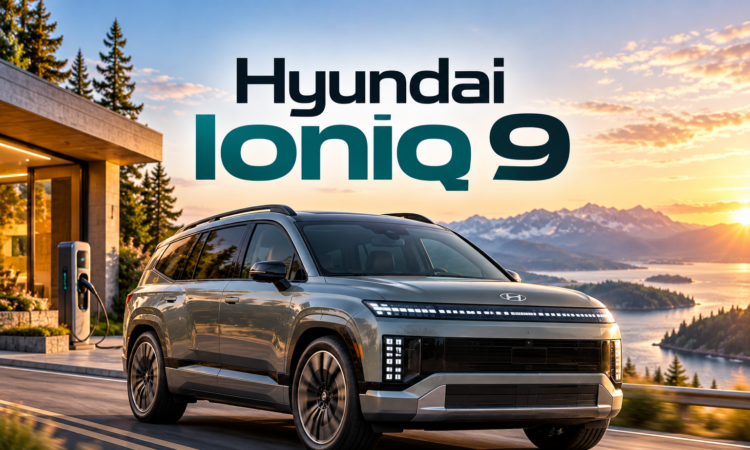
The hyundai ioniq 9 conquest rate has become one of the more interesting numbers around Hyundai’s new three-row electric SUV. Data shared by Hyundai, citing 2025 calendar-year S&P Global Loyalty household methodology, showed a 64.3% conquest rate for the Ioniq 9. In simple terms, nearly two-thirds of the households represented in that data were new to the Hyundai brand rather than repeat Hyundai buyers.
That figure matters because the 2026 Hyundai Ioniq 9 is not a low-cost entry model. Car and Driver lists an MSRP range of roughly $60,605 to $79,140, with six- or seven-passenger seating, 311 to 335 miles of EPA-estimated range, and a 110.3-kWh battery. Convincing buyers to enter Hyundai through a large electric SUV in this price bracket is strategically different from simply retaining an existing Hyundai household.
What Does a 64.3% Conquest Rate Actually Mean?
In automotive marketing, a conquest sale generally means a buyer switches from another brand. A conquest rate therefore measures how effectively a model attracts households that did not previously belong to that automaker.
The 64.3% figure came from a Hyundai slide cited by Torque News and was based on 2025 calendar-year S&P Global Loyalty household data. It is not market share or sales growth; it measures how many buyers are new to Hyundai.
According to Torque News’ report on Hyundai’s early buyer data, Hyundai said early demand was particularly strong among families waiting for a three-row EV and existing EV owners looking to move into a larger vehicle. Hyundai characterized the Ioniq 9 as being chosen as a family SUV first, with electrification adding to the appeal rather than defining the whole purchase.
How Does the Ioniq 9 Compare With Other Hyundai Models?
| Hyundai model | Reported conquest rate | What it suggests |
| Ioniq 5 | 69.8% | Very strong ability to attract buyers outside Hyundai |
| Ioniq 9 | 64.3% | High new-to-brand rate for a large three-row EV |
| Elantra N | 61.9% | Performance model draws enthusiast buyers from elsewhere |
| Palisade | 61.2% | Strong conquest performance in the three-row SUV segment |
| Kona Electric | 60.9% | EV buyers frequently arrive from other brands |
| Santa Cruz | 58.3% | Distinctive pickup-crossover attracts nontraditional buyers |
| Santa Fe | 57.2% | Mainstream family SUV still brings in many new households |
These figures came from the same Hyundai-provided data set. Hyundai’s Ioniq EVs sit near the top, with the Ioniq 5 at 69.8% and the Ioniq 9 at 64.3%.
It does not prove EVs automatically create more brand switching, but it suggests the Ioniq sub-brand is a strong acquisition tool.
Why Is the Ioniq 9 Pulling in Buyers From Other Brands?
It Solves a Real Three-Row Family Problem
The Ioniq 9 targets families that need six or seven seats, a usable third row, and meaningful cargo space.
Car and Driver measured 22 cubic feet behind the third row, 47 cubic feet with it folded, and about 87 cubic feet with all rear seats down. That makes it easier to compare with mainstream family SUVs.
Range Is Competitive Enough for Mainstream Buyers
Range is another contributor. The rear-drive Ioniq 9 is EPA-rated at 335 miles, SE and SEL AWD models at 320 miles, and Performance AWD versions at 311 miles.
Car and Driver’s 75-mph highway test of a Performance AWD model returned 260 miles. That is below the EPA figure, as is common at sustained highway speeds, but it still gives families a more practical road-trip starting point than early three-row EVs with shorter official ranges.
Fast Charging Reduces One of the Biggest EV Frictions
The Ioniq 9 uses Hyundai Motor Group’s E-GMP electrical architecture and supports high-voltage DC fast charging. Hyundai claims a 10% to 80% charge in about 24 minutes on a properly operating 350-kW fast charger under suitable conditions.
Charging speed matters for family travel. The Ioniq 9’s combination of range and fast charging makes it easier to compare with gasoline family SUVs on usability rather than novelty.
What Does the Ioniq 9 Offer Beyond the Conquest Number?
| 2026 Ioniq 9 detail | Current figure |
| Starting MSRP shown by Car and Driver | $60,605 |
| EPA-estimated range | 311-335 miles |
| Battery | 110.3 kWh |
| Power output | 215 hp RWD; 303 hp AWD; 422 hp Performance AWD |
| Performance AWD 0-60 mph, C/D test | 4.4 seconds |
| DC fast charging claim | 10-80% in about 24 minutes |
| Seating | 6 or 7 passengers |
| Maximum towing | 3,500 lb RWD; 5,000 lb AWD |
| Cargo behind third row | About 22 cu ft |
The Ioniq 9 is built in Georgia for the U.S. market. Its cabin emphasizes quietness, lounge-like seating, a flat floor, multiple USB-C ports, and a sliding center console.
Car and Driver rates the 2026 Ioniq 9 at 9.5 out of 10 and places it second among its current best electric midsize SUVs, behind the Kia EV9. That context is important because conquest buyers are not entering Hyundai solely because of incentives; the vehicle itself is being evaluated against some of the strongest three-row EVs available.
Warranty coverage may also reduce perceived risk for new-to-brand shoppers. Car and Driver lists a five-year/60,000-mile limited warranty plus 10-year/100,000-mile powertrain and battery coverage, giving first-time Hyundai buyers a long protection window.
Does the Sales Data Support the Conquest Story?
Sales growth provides useful context, but it needs careful interpretation. Hyundai Motor America reported 1,145 Ioniq 9 sales in May 2026, up 279% from 302 in May 2025. Through May, year-to-date sales reached 4,001 units compared with 302 a year earlier.
Those figures come from Hyundai Motor America’s May 2026 sales release. The percentage increase is dramatic, but the comparison is influenced by the Ioniq 9 being in its launch period during 2025, when inventory and national availability were still ramping up.
By August 2026, Hyundai reported 6,147 Ioniq 9 sales year to date, up 98% from 3,102 in the same 2025 period. August volume was down 42% year over year, showing why conquest and sales volume are separate metrics.
Why Hyundai Calls It a Family SUV First
The most revealing part of Hyundai’s statement is the emphasis on space, range, and usability. That suggests the company does not want the Ioniq 9 to depend only on shoppers who already identify as EV enthusiasts.
A family may care first about third-row comfort, luggage space, charging confidence, and monthly payment. If the Ioniq 9 clears those hurdles, the electric drivetrain becomes an added advantage instead of the entire reason to buy.
How Important Are Lease Offers to the Conquest Rate?
Hyundai specifically mentioned competitive lease options when discussing Ioniq 9 demand. Leasing can be especially useful for conquest buyers because it reduces some of the uncertainty around long-term EV resale values, battery technology changes, and future pricing.
A shopper new to Hyundai or EVs may be more willing to try both through a lease than through long-term ownership. That makes leasing part of the acquisition strategy, not merely a discounting tool.
What the 64.3% Figure Does Not Prove
A high conquest rate is encouraging, but it does not automatically prove long-term brand loyalty. Hyundai still has to retain these buyers when their leases end or when they replace the Ioniq 9 years later.
The figure also comes from early ownership data. New models can attract early adopters, and the rate may change as inventory, incentives, and competition evolve.
Finally, conquest does not mean every buyer came directly from Toyota, Ford, Honda, Tesla, or another specific rival. The public data cited here identifies new-to-Hyundai households, not a complete brand-by-brand list of what each buyer traded in.
Why the Ioniq 9 Matters Strategically for Hyundai
A conquest sale gives Hyundai access to a household it did not previously serve, creating future opportunities for service, financing, and repeat ownership.
The Ioniq 9 is especially important because it enters Hyundai above $60,000, where shoppers may compare both mainstream and premium brands. Winning those buyers can help broaden Hyundai’s image.
Frequently Asked Questions About the Hyundai Ioniq 9 Conquest Rate
What Is the Hyundai Ioniq 9 Conquest Rate?
Hyundai-provided data citing 2025 calendar-year S&P Global Loyalty household methodology showed a 64.3% conquest rate, meaning roughly 64 out of every 100 represented buyer households were new to Hyundai.
Is 64.3% High for Hyundai?
Yes. In the Hyundai comparison reported from the same data set, only the Ioniq 5 was clearly higher at 69.8%. The Ioniq 9 was above important models such as the Palisade, Kona Electric, Santa Cruz, and Santa Fe.
Does the Conquest Rate Mean the Ioniq 9 Is Outselling Other SUVs?
No. Conquest rate measures where buyers came from, not how many vehicles were sold. Sales volume, market share, loyalty, and conquest are separate measures.
Why Are New Buyers Considering the Ioniq 9?
Hyundai says buyers are responding to family-SUV fundamentals such as space, range, and usability. Car and Driver’s testing also highlights a quiet cabin, practical three-row packaging, 311 to 335 miles of EPA range, and rapid charging capability.
What Is the Bottom Line?
The Hyundai Ioniq 9 conquest rate is significant because 64.3% of the households in Hyundai’s reported 2025 data were new to the brand. For a three-row EV starting above $60,000, that is a strong early indication that the Ioniq 9 is reaching beyond Hyundai’s existing customer base.
The most plausible explanation is not one headline feature. The Ioniq 9 combines practical seating and cargo space, more than 300 miles of EPA range across the lineup, quick charging, strong performance options, and competitive lease positioning. The next test is whether Hyundai can turn those conquest buyers into repeat Hyundai customers after the first lease or ownership cycle.